
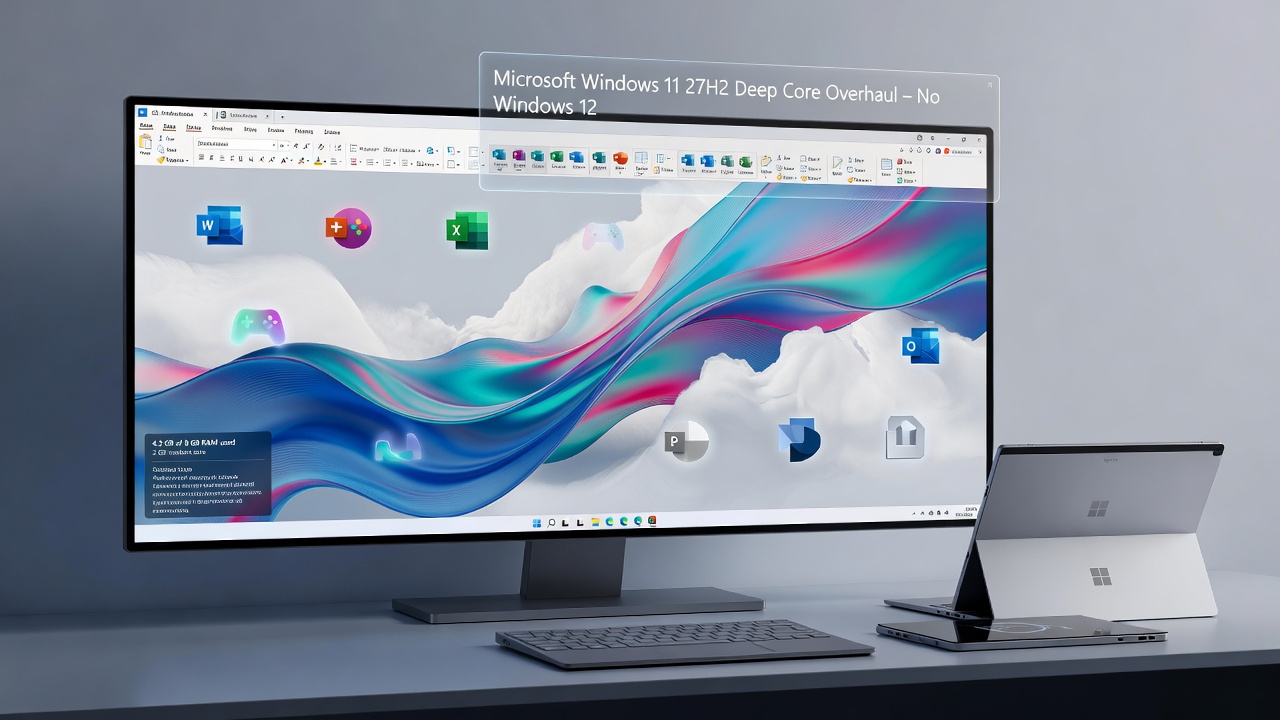
Microsoft is preparing a significant overhaul of Windows 11, internally tracked as version 27H2 and expected in 2027, that goes well beyond the usual annual feature update. Rather than launching a new Windows 12, the company appears to be concentrating its engineering resources on rebuilding core system components, improving memory efficiency and refreshing the operating system's visual identity.
A core replacement, not just a feature drop
According to people familiar with Microsoft's plans, 27H2 will differ from recent updates like 25H2 and 26H2, which largely arrived as incremental monthly feature packages. Instead, this release is described as a fuller replacement or deep upgrade of key operating system components. Testing through the Windows Insider program is expected to begin earlier than the typical June start, giving Microsoft more runway to validate changes before a broader rollout.
Memory optimization aimed at lower-end hardware
Alongside the architectural work, Microsoft has been quietly improving how Windows 11 manages RAM, particularly on machines with 8 GB of memory - still common in budget and mid-range PCs. Windows Director Pawan Davuluri said the system can now keep up to 2 GB of active data in RAM rather than offloading it to the slower disk-based paging file, which should reduce how often open apps or browser tabs need to reload after being left idle. Independent testing by Windows Central reportedly confirmed measurable reductions in memory use within the OS itself and in Microsoft's Office applications, including Word, Excel, PowerPoint and Outlook.
A new look to accompany the new plumbing
Microsoft is also retiring the Bloom wallpaper that has represented Windows 11 since its 2021 launch, replacing it with new abstract designs featuring colored curves set against cloud-like backgrounds. Separate variations are being prepared for consumer and enterprise editions, with the consumer version reportedly leaning toward gaming and content creation themes, while the business-focused design emphasizes productivity. The redesign is expected to be formally unveiled at Microsoft's Ignite conference this month, with a full rollout anticipated in early January.
Context: an industry-wide push against bloat
The memory-efficiency work fits a broader pattern across the software industry of addressing long-standing complaints about resource-heavy applications. The report notes that Discord is separately rewriting its desktop app in the Rust programming language to move away from the Electron framework, which has drawn years of criticism for high memory consumption. For Windows users, the practical takeaway is that Microsoft's 2027 update is being framed less as a flashy rebrand and more as an effort to make the existing operating system run more smoothly on the hardware people already own.