
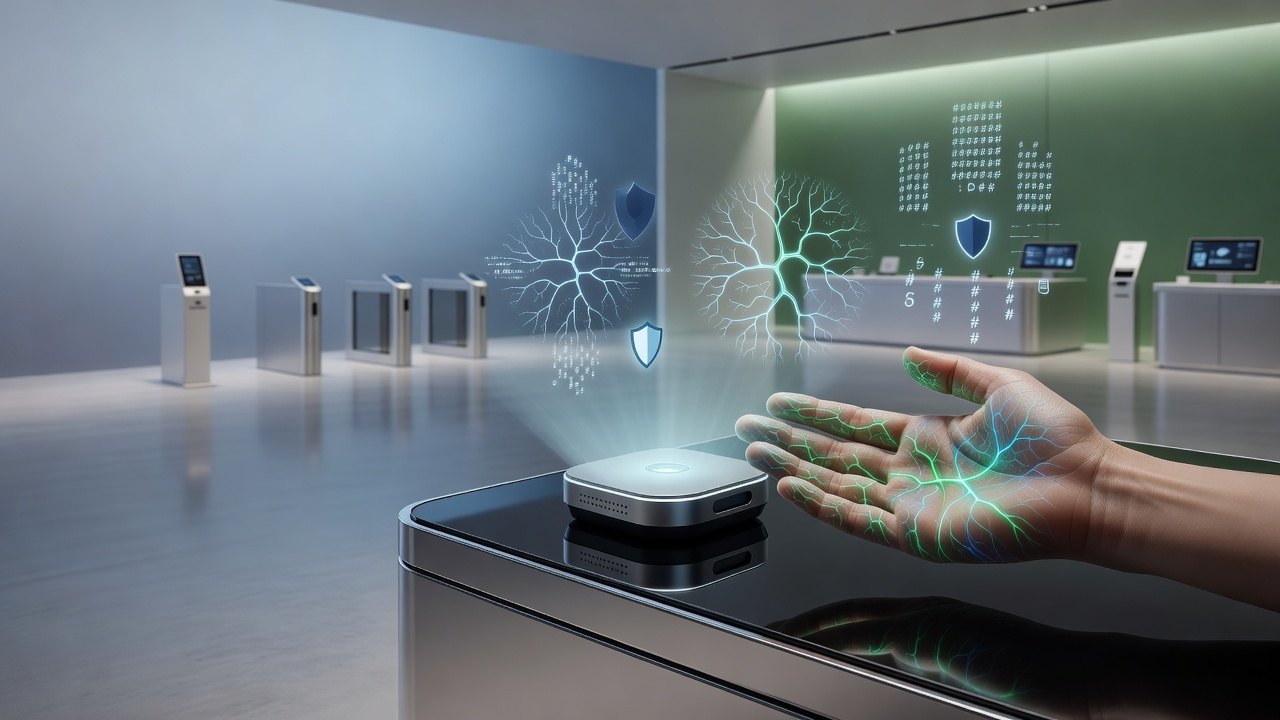
Veyns, a company building biometric authentication hardware and software, is targeting a market launch by the end of the fourth quarter of 2026. Its core technology reads the vein pattern beneath a person's skin to confirm identity, an approach the company argues could eventually replace passwords, access cards and one-time codes across payments, building access, loyalty programs and digital wallets.
How palm vein authentication works
Unlike fingerprint or facial recognition, which rely on visible surface features, palm vein scanning reads the vascular pattern inside a person's hand along with signals meant to confirm liveness - that is, that a real, living person is present rather than a photo, mask or synthetic replica. Veyns says this method is designed to address a growing problem: as AI tools make it easier to clone voices, generate convincing images and manipulate documents, systems that verify identity through static, visible traits are becoming easier to spoof.
The company's initial hardware lineup includes a compact palm vein reader called the Bio Signature Disk and a point-of-sale terminal built around the same scanning technology. Veyns describes these as a first edition rather than a finished product line, with further iterations expected as the company approaches its 2026 launch window.
Software tools aimed at developers, not just hardware buyers
Veyns says it intends to release software development kits (SDKs) and application programming interfaces (APIs) so that outside developers and businesses can build their own applications on top of the palm vein system, rather than relying solely on Veyns-branded devices. That strategy, if realized, would position the company as an identity infrastructure provider whose technology could be embedded into third-party payment systems, access-control products or digital identity services, rather than as a maker of standalone scanners.
The company frames payments and building access as initial use cases, with longer-term ambitions that include reusable identity verification (KYC), portable credentials and applications in travel and government services. These broader goals remain aspirational and unproven at this stage, since the core product has not yet shipped.
Privacy design and open questions
Veyns states that it does not store raw images of a user's palm vein pattern. Instead, the company says scans are converted into mathematical vectors and then processed through cryptographic hashing to produce a secure template used only for verification, rather than a reconstructible biometric image. This approach is intended to reduce the risk of creating a centralized database of sensitive biological data that could be stolen or misused.
As with any biometric system, real-world trust will depend on independent verification of these privacy claims, interoperability with existing payment and access infrastructure, and how the technology performs outside controlled conditions. Veyns has not yet launched commercially, and details on pricing, availability, and third-party security audits were not provided.