
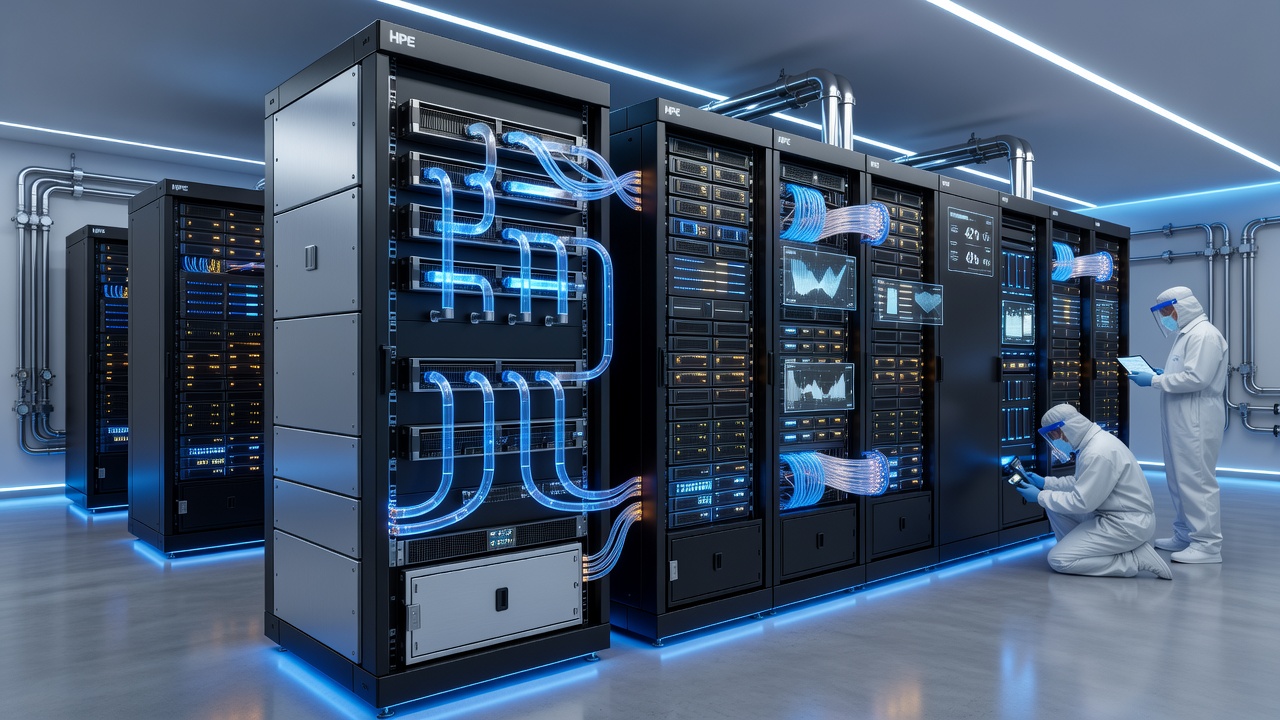
Hewlett Packard Enterprise has introduced new infrastructure aimed at organizations running demanding hybrid supercomputing and AI workloads, combining a storage system built for high-throughput data access with a liquid-cooled controller designed to manage power and thermal demands at the rack level. The announcement targets data centers that need to move large volumes of data quickly while keeping dense, high-performance hardware running efficiently.
What the storage platform addresses
Hybrid supercomputing environments typically mix traditional high-performance computing workloads with AI training and inference, each with different data access patterns. A storage system built for this mixed use case has to handle both sequential throughput for large simulation datasets and the more random, high-volume I/O patterns common in machine learning pipelines. HPE's new offering is positioned to serve both needs within a single architecture, reducing the complexity of maintaining separate storage tiers for different workload types.
For enterprise IT teams, this kind of consolidation can simplify procurement and management, though actual performance in production will depend heavily on network topology, data pipeline design and how workloads are distributed across available nodes. Organizations evaluating this type of system should request workload-specific benchmarks rather than relying solely on vendor-supplied figures.
Liquid cooling and rack-level control
The companion rack controller uses liquid cooling, a technique increasingly common in facilities running dense GPU and accelerator clusters, where air cooling alone struggles to remove heat efficiently. Liquid cooling circulates coolant directly to or near heat-generating components, allowing higher rack power densities without the airflow and spacing constraints traditional air-cooled designs require.
Describing the controller as "intelligent" suggests it incorporates monitoring and automated adjustment capabilities, likely covering temperature, flow rates and power distribution across the rack. Such systems typically aim to maintain stable operating conditions while flagging anomalies before they cause hardware failures. The practical benefit for data center operators is the potential to pack more computing capacity into existing floor space while managing energy and cooling costs more predictably, though the specific efficiency gains depend on facility design and workload patterns.
Practical considerations for adopters
Liquid-cooled infrastructure generally requires facility modifications, including plumbing for coolant distribution, and may involve different maintenance procedures compared to conventional air-cooled racks. Organizations considering this path should factor in installation complexity, staff training and long-term serviceability alongside raw performance claims.
- Mixed HPC and AI workloads benefit from storage designed for varied I/O patterns.
- Liquid cooling supports higher rack density but requires facility-level planning.
- Automated monitoring in the controller aims to reduce thermal and power-related downtime risk.
As with any new infrastructure announcement, independent verification of performance and reliability claims will matter most once the systems are deployed in real-world data centers handling production-scale workloads.