
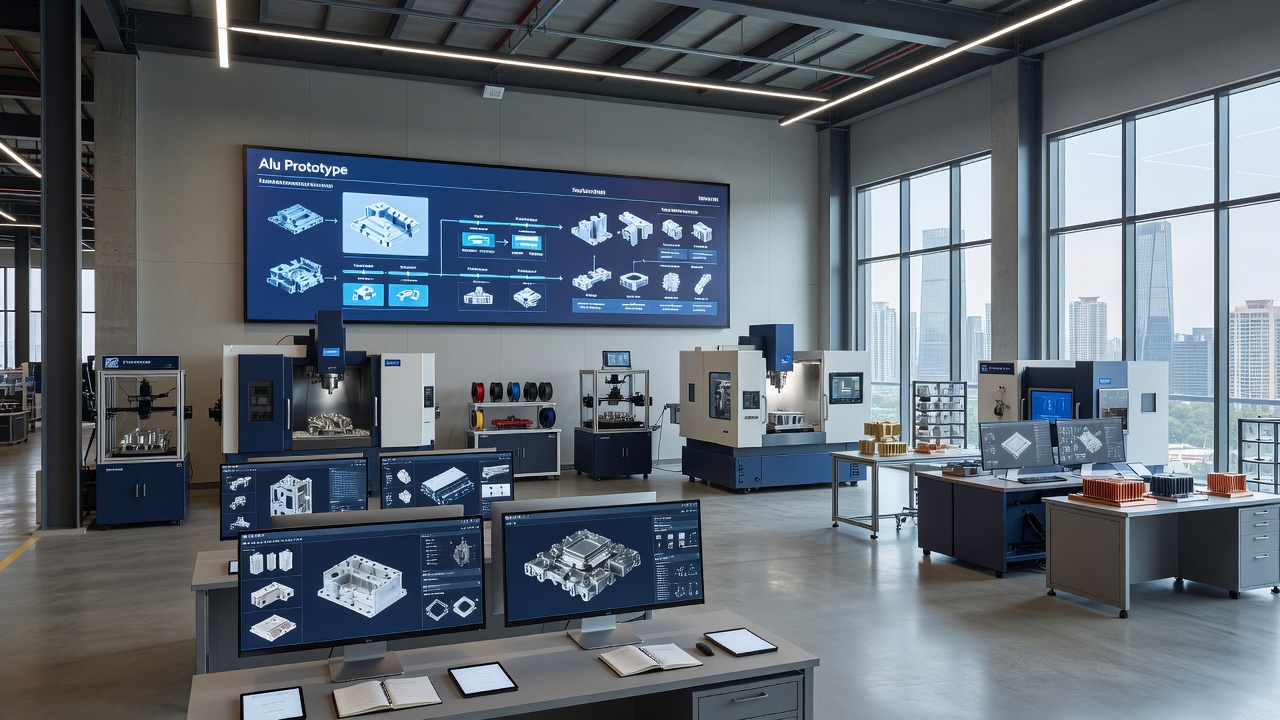
A Shenzhen-based manufacturer, Alu Prototype, is positioning itself as a single-source supplier for companies that need to move quickly from CAD files to physical hardware. The company, founded in 2010, consolidates several manufacturing processes - including CNC machining, die casting, injection molding and 3D printing - into one coordinated service, an approach aimed at reducing the logistical burden of managing multiple vendors during product development.
How the consolidated manufacturing model works
Product development often requires different processes at different stages: a 3D-printed prototype to check form and fit, a CNC-machined part for functional testing, and injection-molded or die-cast components for small production runs. Normally, engineering teams have to source each of these capabilities from separate shops, each with its own quoting process, lead time and quality standards. Alu Prototype says it addresses this by offering CNC milling and turning across 3-, 4- and 5-axis equipment, alongside aluminum die casting, vacuum casting, sheet metal fabrication and a range of surface finishes such as anodizing, bead blasting and powder coating, all within one operational network. For engineering teams, the practical benefit is fewer handoffs between suppliers and, in principle, more consistent communication about tolerances and specifications as a part moves from prototype to production.
Materials, tolerances and where the limits lie
The company lists a fairly broad materials catalog: aluminum alloys including 6061, 7075 and 2024, along with steel, stainless steel, titanium, brass and copper, plus engineering plastics such as ABS, polycarbonate, PEEK, nylon and POM. Alu Prototype states that machining tolerances can reach ±0.01 mm "for suitable projects" - a qualifier worth noting, since achievable tolerance in CNC machining depends heavily on part geometry, material behavior and fixturing, not just machine capability. Buyers evaluating any precision-manufacturing vendor should treat such figures as a ceiling under favorable conditions rather than a guarantee across all designs. Similarly, the claim that some prototypes can be completed in as little as three days is presented as dependent on material, geometry, quantity and finishing requirements, meaning actual turnaround will vary by project.
Quality systems and sector applications
Alu Prototype says its quality-management systems are certified to ISO 9001:2015 and ISO 14001:2015, standards that cover quality-control processes and environmental management, respectively. The company states inspection is built into its production stages rather than applied only at final delivery, which is a common practice among contract manufacturers serving regulated or safety-sensitive industries. Target sectors include automotive, aerospace, robotics, automation, electronics, medical devices and energy - fields where housings, brackets, structural parts, fixtures and heat sinks frequently require tight dimensional control and documented traceability.
Practical considerations for engineering teams
For companies evaluating a manufacturing partner, the appeal of a bundled service is speed and reduced coordination overhead - one quoting process, one point of contact, and a workflow that can, in theory, carry a part from early prototype to low- or medium-volume production without switching suppliers. Alu Prototype also offers design-for-manufacturing feedback on submitted STEP, IGES or STL files, which can help identify costly geometry issues before parts are cut. As with any outsourced manufacturing relationship, prospective customers should independently verify lead times, tolerances and certifications for their specific part and quantity before committing to a production schedule.